Vietnam Culinary Discovery – Day 11, Ho Chi Minh City

Tuesday 9th December, 2014

This morning’s activity is a market tour and our final hands-on culinary lesson at the Saigon Cooking Class. Kylie and I arrive early at the well known Ben Thanh Market to meet our guide from the cooking school, Khang, and the rest of the class participants.

Khang leads our group through to the live fish market to introduce us to the different types of fish and seafood that are native to southern Vietnam. As we progress through the stalls, there are trays of crabs that are sitting perfectly still in neatly assembled rows. To the naked eye, they seem to be either dead or asleep until your hand moves towards them and suddenly their claws break ranks and lunge for your fingers. Kylie was having a lot of fun playing with one particular crab and thankfully her reflexes were still fairly sharp as he was extremely feisty and very much alive.

Progressing towards the meat market, Khang makes a classic declaration to the group, “In Asia, we eat everything moving”. I think we had worked that out when we saw the frogs at the market in Hanoi! To my right there is a stall selling every single part of a pig, from nose to tail, with each organ or body part neatly displayed for the passing customers to purchase.
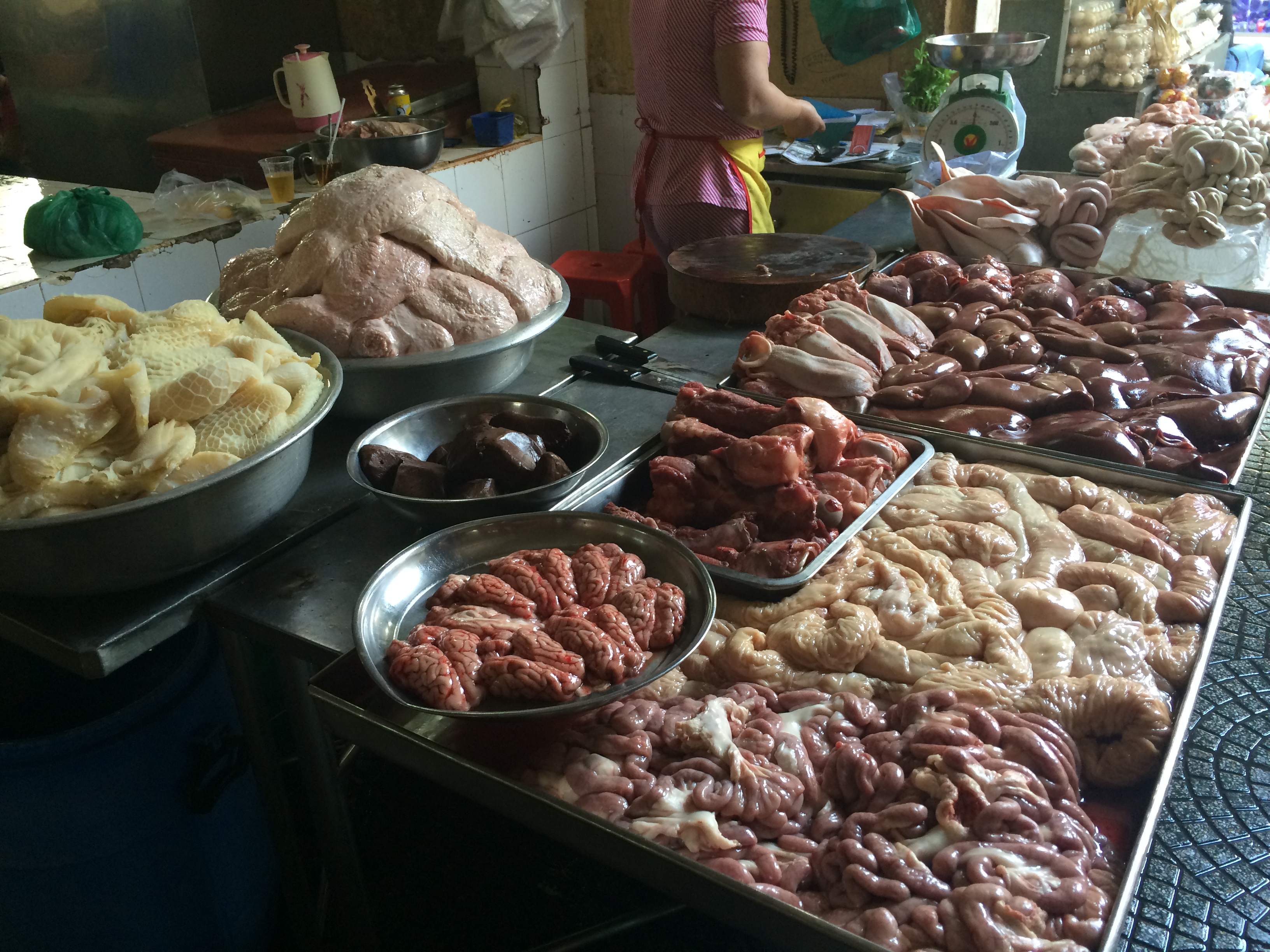
Pig for sale, Market tour - Saigon Cooking Class, HCMC - Vietnam Culinary Discovery
Pig for sale, Market tour – Saigon Cooking Class, HCMC – Vietnam Culinary Discovery

As we purchase ingredients required for the day’s cooking lesson, Khang explains how different products are made and where they are used. Our group heads further into the market, through the narrow alleys and passages to look at fermented vegetables, dried fish, fresh noodles and all manner of food available for sale.

Our market tour concludes and we make our way back cross town to the Hoa Tuc restaurant to prepare for the cooking lesson. The cooking school is held upstairs above the restaurant and is beautifully appointed with elegant furnishings, rich purple accents and Vietnamese kitchen wares available for sale. Just as we take our seats at the long bench, our market guide Khang reappears without his glasses and has now performed his own Clark Kent/Superman transformation into super Chef Khang.

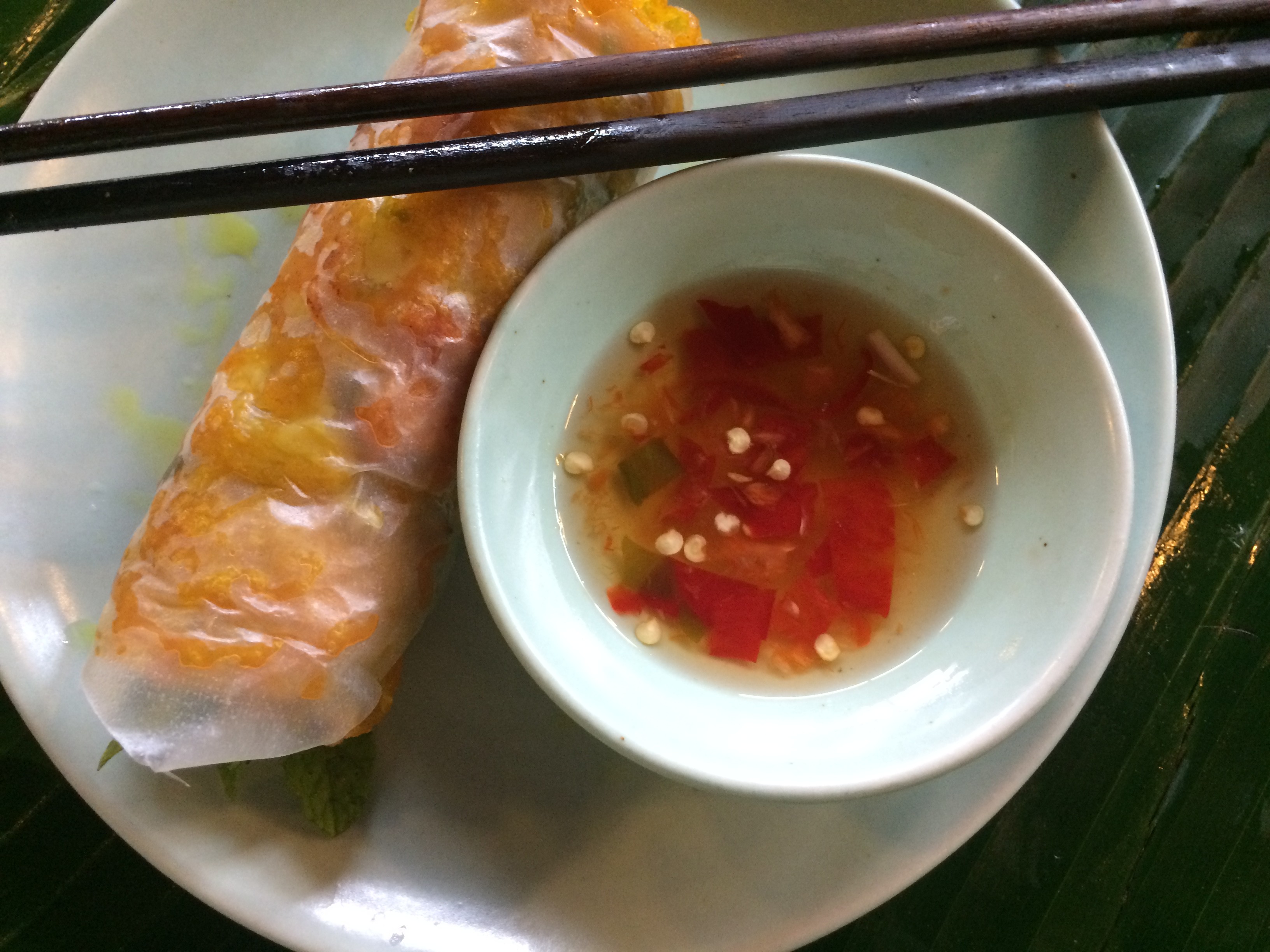
The menu for Tuesday comprises of Fresh rice paper rolls with prawns, pork and rice noodles served with peanut dipping sauce; Green mango salad, baby spinach and BBQ chicken with satay;  and Fried rice with lotus seeds, prawns, chicken and vegetables in a lotus leaf and I’m excited that I finally learn firsthand how to create my own rice paper rolls.

This is the first cooking class where I get to be seated for the entire session and something that I could very much become accustomed to, especially as all the ingredients and their exact quantities have been already individually prepared and ready for use.

Before preparing the rice paper rolls, the first process is to prepare the peanut dipping sauce. Khang was extremely patient and clear with his instructions as he stepped us through each step involved in preparing the sauce. The novelty factor was using an Asian-style china soup spoon for all the measuring and stirring, and just like the chopsticks in the previous cooking class, these spoons are now part of my key kitchen utensils.

With the sauce prepared and pushed to the side, we set to work on preparing the prawn and pork rice paper rolls. Khang showed us how to soften the rice paper on the plate with wet fingers rather than soaking them in a bowl of water, and then demonstrated how to assemble all the ingredients together to create the end product, complete with chive decoration. For the next five minutes we prepared and perfected our own rolls. Typically, the first one was passable and the second one was almost restaurant quality. Once we had finished preparing our rolls, we moved to the dining table to enjoy our own handiwork. The dipping sauce was fantastic and the rice paper rolls were equally delicious – this dish is now going to be a staple at home.

It was tempting just to sit and continue eating all day but Khang enticed us back to our seats to start the next dish. Whilst we were eating, the kitchen elves had cleaned down our work stations and laid out a new set of ingredients to use. The next step in the process was to finely chop garlic, shallots and combine the satay paste to marinate the chicken. Once the marinade had been prepared, our bowls where whisked away for the meat to be barbequed while we set to work on the dressing for the salad.

Armed with our trusty Asian soup spoons, we measured out the ingredients required for the sweet and sour dressing, stirred to dissolve and set aside. Khang introduces the class to a new kitchen tool that will be used to “julienne” the green mango and carrot. We practice finely chopping the vegetables with the crinkle-cut blade to prepare the salad before adding in a few sprigs of watercress, Vietnamese basil, baby spinach, sliced shallots and chopped peanuts.

In the space of a few minutes, we had all assembled a very elegant salad to accompany our char-grilled chicken, which had now magically appeared on our plates. The only thing left to do was to head back to the dining table and consume our latest efforts. Yum!
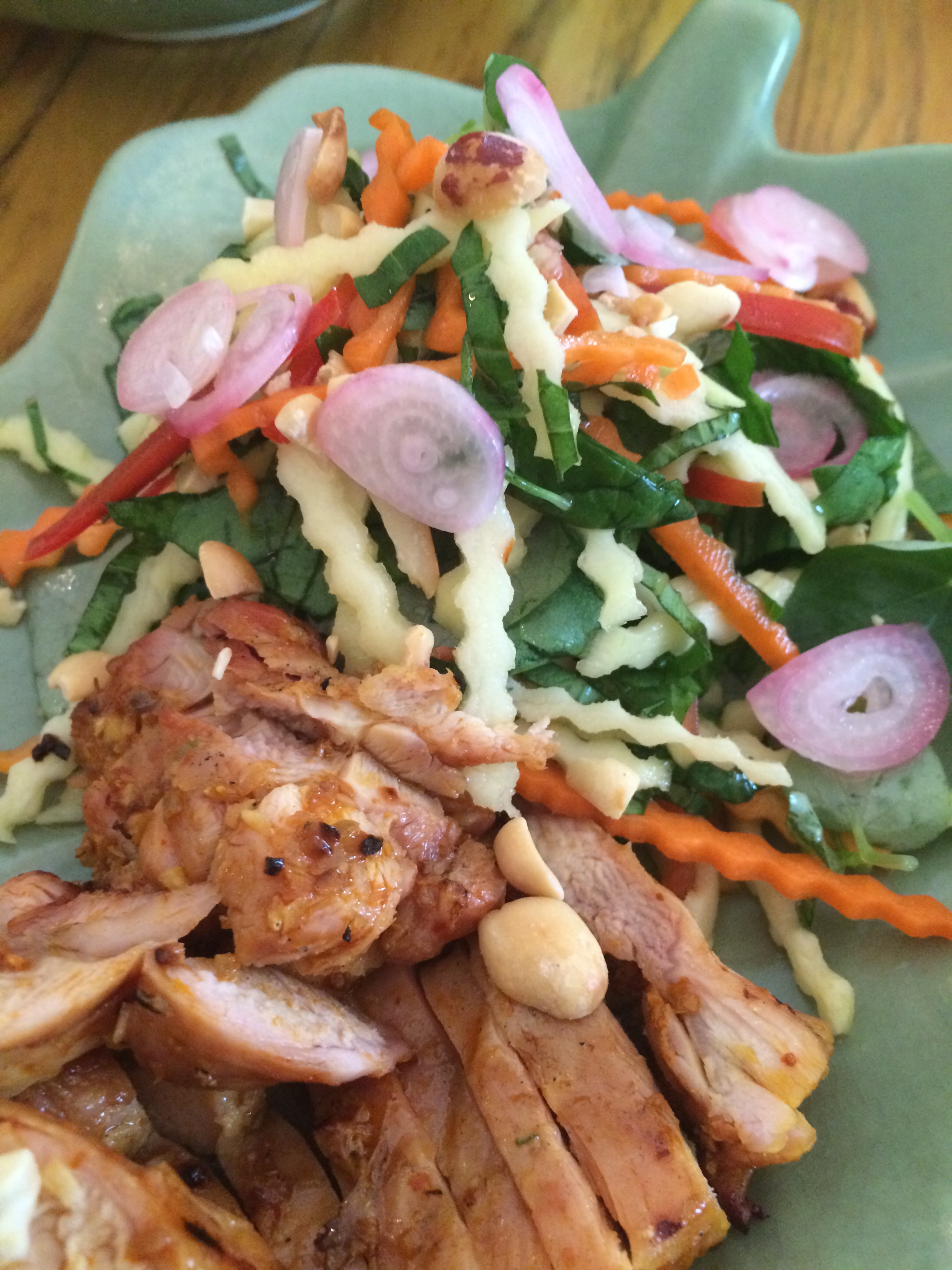
Green mango salad with char-grilled chicken, Saigon Cooking Class, HCMC - Vietnam Culinary Discovery
Green mango salad with char-grilled chicken, Saigon Cooking Class, HCMC – Vietnam Culinary Discovery

Whilst the menu so far seemed to be simple and easy to re-create, things took a more complicated turn when we returned back to our preparation stations. Our next dish was to prepare a Lotus fried rice in lotus leaf, which was essentially a dish that the King used to command to test his royal chefs. So far on our tour, the dishes we had been learning were all designed to impress future mother-in-laws only! Faced with small portable stoves and a large wok, we set to work cooking the fried rice aided by Khang providing the necessary instructions to ensure that the dish was created to an imperial standard.

With the rice pushed to one side temporarily, the hard work was yet to come. Khang demonstrated the next stage of the process by lining a bowl with the lotus leaf and then filled the bowl with the fried rice mixture. Flipping the bowl over, the rice was wrapped in the rest of the lotus leaf to form a small parcel. If I thought that part was tricky, armed with scissors I needed to cut holes into the lotus leaf to be able to form a decorative bowl and expose the fried rice inside before decorating with lotus petals.

And we’re finished! After all that exertion, it was time to assume our royalty positions and eat our rice, which tasted great especially with the addition of the lotus seeds, although I’m not sure where I can source them back home in Melbourne. In between mouthfuls, our passionfruit dessert which had been kindly prepared for us, was served for our enjoyment. It truly was a feast fit for a king.

Chef Khang rematerialised to present us with a booklet which included our recipe sheets and a personalised message. It was such a great morning and a fun and memorable cooking class. Having now undertaken three classes in Vietnam, it was satisfying to know that we had now learnt several new recipes to add to our culinary repertoire which we could perfect in our kitchens back home.

We have already spent two nights in HCMC but have yet to see the key monuments, so the focus of our afternoon activity will be a city tour. Our first stop is to visit the Reunification Palace which is of significant historic importance in Vietnamese history. If this building could talk it could tell a few hair-raising stories about its occupation by the French, followed by the Japanese and then by the King of South Vietnam until the events of 1975 saw a dramatic conclusion to his reign.

While Binh was somewhat apologetic for the 1960s décor inside, I thought I had (stylishly) stepped back in time with lavish furniture and elaborate chandeliers in the key meeting rooms – almost like a retro version of “The West Wing”. The whole tour was fascinating, including visiting the basement which served as a bunker and communications centre during the war.

This year will mark the 40th anniversary since the end of the Vietnam War and the next stop on our city tour is a very sobering visit to the War Remnants Museum. The grounds of the museum display tanks and aircraft used in the war, whilst inside there are some very graphic images and heartrending stories shown inside the various galleries, I was thankful for the opportunity to visit and to learn more about that period of time.

After the visit to the museum concludes, the tour takes a European perspective and we continue towards the city centre to visit the impressive Notre Dame Cathedral, which is the largest church ever built in the French empire. Built with materials imported from Marseilles, the church is extremely beautiful and if you close your eyes slightly you really do feel like you are in Europe.

Metres away from the cathedral, lies the General Post Office which is just as impressive. The building was design by French architect Gustave Eiffel so it was elaborate in both detail and grandeur. Such a shame I don’t send postcards anymore!

We were within walking of our hotel which is where we bid adieu to our local guide Binh as today is our last guided day in Vietnam. Although we only had Binh’s company for a couple of days, we really enjoyed his humour and affable manner.

As soon as Binh was out of sight, Kylie and I set off across town to locate a distinctive building that stands out against the city skyline. With impressive views of Ho Chi Minh City, what better way to enjoy our final Happy Hour in Vietnam by watching the sunset from the 52nd floor at the EON Heli Bar. Using the tall building as our beacon, we arrived in time to secure a table with a stunning view and watch the sun set over Saigon.

http://www.tripadvisor.com.au/Attraction_Review-g293925-d4305638-Reviews-EON_Heli_Bar-Ho_Chi_Minh_City.html

Kylie and I are responsible for sourcing our own dinner again and ever since arriving in Vietnam, I’ve been wanting to indulge my Francophile fantasies and experience Vietnamese-French fusion cuisine. La Fourchette is a small, French bistro that is included in Insider Journey’s list of recommended culinary discoveries in HCMC, and has an unique interior that is reminiscent of a Parisian establishment despite being in a suburban Asian street.

Kylie and I make ourselves comfortable with a bottle of Beaujolais and look over the extensive menu – there are so many dishes that it takes a little while to decide what to order for our dinner in Vietnam. Selecting a cross-section of hot and cold dishes we chose Tuna tartare with wasabi and sesame seeds; Smoked duck salad with red capsicums; Veal shoulder cooked with tomatoes, white wine, olives and spices; and Fresh fried salmon fillet with leeks fondue.

Dinner was superb with generous-sized dishes, great service and a relaxed ambience. I couldn’t resist trying the Flambee bananas in rum with vanilla ice cream to finish off our evening.

http://www.tripadvisor.com.au/Restaurant_Review-g293925-d1122177-Reviews-La_Fourchette-Ho_Chi_Minh_City.html

Disclaimer: All entries regarding the Vietnam Culinary Discovery tour within this blog reflect my own personal insights and experiences throughout my holiday and I was solely responsible for meeting all travel expenses incurred.

Vietnam Culinary Discovery – Day 8, Hoi An

Saturday 6th December, 2014

A week has almost passed since our first cooking class in Hanoi, and this morning Kylie and I are excited to be able to experience our second class at the famed Ms Vy’s cooking school in Hoi An.

Our “Holiday Masterclass” is scheduled to start at 8.30am so we arrive early at the Market Restaurant and Cooking School and are treated to a special welcome drink before our class begins. I’ve been on culinary tours where you get a shopping list or bag to take to the market, however things got a little serious when we were each given a Vietnamese-style straw conical hat to wear as part of the market tour. On the short walk to the dock, a few local residents and fellow tourists were having a few laughs at our expense. When in Hoi An, I guess …

The tour starts with a short boat trip along the Thu Bon River to the Hoi An’s Central Market near the Old Quarter. Once at the market, our guide leads us to a small stall situated on the outskirts of the main building. Here our guide starts to teach us about the key elements of Vietnamese cuisine, as samples of differing spices and herbs are passed around the group for tasting. I’ve always been intrigued as to how chives and spring onions are expertly shredded and used as decoration for a number of Asian dishes, and within a matter of seconds the stall holder “splits” the morning glory herb using a kitchen tool called a “splitter”. She then used a stainless steel conical tool to demonstrate how to peel a carrot which is then fashioned into a decorative flower. As soon as I saw these utensils, I knew I just had to have them for my own kitchen, all for the bargain price of 90,000 VND ($5 AUD).

After the demonstration, we then head into the meat section of the market to look at the fresh produce, then past the noodles, towards the fish market and through more fresh fruit and vegetable stalls. The market was relatively quiet for a Saturday as it is a full moon day, which requires practising Buddhists to fast and make particular food offerings. On the way back towards the boat, our last stop is at a fruit stall to try fresh rambutan and other tropical fruit native to the area.

We arrive back to the Market Restaurant via the same route, return our conical hats and freshen up with a another cold drink. At this point, I thought we would be heading upstairs to commence our cooking lesson however our hostess asks us to follow her towards a stall inside the restaurant hall where we commence a special informative food tour which takes us on a unique tasting journey right around the entire perimeter of the ground floor, coupled with live cooking demonstrations. The Market Restaurant is quite a unique dining experience where popular street food and traditional Vietnamese cuisine is offered at different stations under one roof, resembling an upscale hawker style market or something akin to Sizzler, Hoi An style. The first stop is to watch rice paper being transformed into large crackers, where we take a sample and try some chilli paste that has just been prepared.

The next stage of our tasting journey takes us to the dumpling station where the group is shown how rice paper is made on a drum before someone is asked to volunteer and have a go themselves. Throughout the demonstration, a team of chefs are busily preparing a variety of different dumplings for the day’s trade and our group is invited to try the famous White Rose dumpling with a special fish sauce and other freshly cooked varieties of dumplings.

We continue onto the next station where chefs are making thick noodles from wet sheets of rice flour, effortlessly cutting the sticky dough into perfectly formed pieces. From the next stall, beef and betel leaves are being grilled over hot coals with the smoky aroma wafting towards us. Thankfully there are hot samples waiting for us to try when we arrive at the station. The next station is cooking baby crispy pancakes (Bánh căn) in hot oil where we are offered another sample in small dishes for tasting.

Continuing around the market we learn about how rice was traditionally ground in a stone mill to create rice flour before watching rice vermicelli being created through an industrial looking machine. At the next station, a woman is finely shredding green mango on a homemade wooden mandoline slicer before progressing across the stall to use a special kitchen tool to slice banana flower into edible pieces. With two-thirds of the market covered, we arrive at the dessert station to try candied coconut and ginger pieces as well as a delicious sample of steamed coconut pudding.

But wait … there’s more. We then sampled cooked pieces of root vegetables used in Vietnamese cooking before moving towards the next station, which resembled both a small delicatessen and bakery, housing baskets of fresh baguettes which could only mean that we were about to learn about Banh Mi. With slices of cured pork meat, fresh herbs, pickled vegetables shown around the group, the attendant at the stall made fresh Banh Mi for everyone to sample and enjoy.

Food tasting tour - Spicy Lemongrass Frog, Ms Vy's Market Restaurant and Cooking School, Hoi An - Vietnam Culinary Discovery
Food tasting tour – Spicy Lemongrass Frog, Ms Vy’s Market Restaurant and Cooking School, Hoi An – Vietnam Culinary Discovery

The last station of the food tour was a selection of traditional fare or Vietnamese worker’s cuisine. From steamed pots of pig’s brain to stir fried frogs, we were all encouraged to taste samples but unfortunately I seemed to be quite full from all the other tastings.

Now it was time to head upstairs, freshen up and prepare ourselves for the day’s cooking class. Kylie and I found a seat towards the front of the room and met our instructor, Lulu, who would be teaching us four Vietnamese dishes over the next couple of hours. Our individual cooking stations were rather unique with a large banana leaf doubling as a chopping board and all the condiments and utensils prepared and ready for our first dish which was a soup, Cabbage leaf parcels with shrimp mousse in broth.

We sat and watched Lulu demonstrate the preparation of the shrimp mousse, all the while listening to her funny insights on cooking for her in-laws and anecdotes from married life. It seems like most soups in Vietnamese cuisine are used as some sort of marriage-suitability test.

Once the shrimp mousse was prepared for the class, we started to prepare our soup broth by first gently poaching a couple of quenelles of prawn mixture. Once cooked, it was time to prepare the parcels using the steamed cabbage leaves at our station and the blanched spring onion to tie it all together. The parcels and vegetables simmered on the gas stove for a few more minutes and very shortly, we had created a very elegant and tasty dish worthy of any future mother-in-law’s palate. We were able to enjoy the soup immediately as our station was being cleaned and prepared for the next dish by our kitchen fairies.

Cabbage leaf parcels with shrimp mousse in broth - Cooking class, Ms Vy's Market Restaurant and Cooking School, Hoi An - Vietnam Culinary Discovery
Cabbage leaf parcels with shrimp mousse in broth – Cooking class, Ms Vy’s Market Restaurant and Cooking School, Hoi An – Vietnam Culinary Discovery

The next order of business was to prepare the ingredients to create a marinade for our BBQ chicken and lime leaves dish.

It all seemed to be as relatively simple as throwing in the required quantity of ingredients into the bowl, mixing it all together with the plastic gloves provided, threading the chicken onto wooden skewers and watching it being whisked away and cooked for our enjoyment later.

The next dish, the classic Banh xeo, was a little more complicated to prepare with Lulu demonstrating how to prepare the batter mixture at the front of the class room before we lit up the gas burners again to create our crepes and fillings. It was fun to dispense with the traditional kitchen utensils and cook only with a set of wooden chopsticks. The tricky bit was turning the crepe over in the hot oil in order to create the half-moon shape, and then having to roll up the Banh xeo on a sheet of soft rice paper, but somehow all the effort paid off. Like most food, Banh xeo is best consumed when hot so as soon as we finished cooking and taking our obligatory photos, it was time to eat again.

Banh xeo - Cooking class, Ms Vy's Market Restaurant and Cooking School, Hoi An - Vietnam Culinary Discovery
Banh xeo – Cooking class, Ms Vy’s Market Restaurant and Cooking School, Hoi An – Vietnam Culinary Discovery

The last dish of the day was to make a Mango and prawn salad, to accompany our BBQ chicken for lunch. Lulu demonstrated how to use the Vietnamese vegetable peeler to first peel the green mango, and then using a knife to make lots of deep cuts into the mango, the peeler was then used again to create the thin julienned shards of mango to be used in the salad. It took a little bit of getting used to actually holding the mango in one hand and being familiar with the odd shaped peeler, but eventually I got there and was quite pleased with the mound of chopped fruit I had created for my salad.

Two hours seemed to fly by and suddenly our class was finished and it was time to head back down stairs to the market dining area and eat our BBQ chicken and salad. But before we left, Lulu gave everyone an envelope containing the recipe sheets and our very own Vietnamese peeler to take home as a gift.

We enjoyed our lunch immensely, accompanied by hot green tea, ice-cream and candied ginger and coconut to finish.

http://msvy-tastevietnam.com/the-market/

Young tailor preparing for full moon,  Hoi An - Vietnam Culinary Discovery
Young tailor preparing for full moon, Hoi An – Vietnam Culinary Discovery

Feeling extremely full, we had to head back to our tailor for our second fitting for the items that we had ordered the previous day. I think I was a little thankful that I was trying on a couple tops and not pants! While my tops were starting to take shape, there was still some more work to be done and another fitting was scheduled later in the evening.

The rest of the day was free for Kylie and I to do some shopping and enjoy the walking around the Old Quarter without our guide, and even to put our feet up and enjoy a Vietnamese coffee break. Ms Vy seems to have a monopoly of culinary enterprises in Hoi An, including a contemporary European-style café and patisserie called the “Cargo Club” which we decided to stop at and watch the world go by.

Old Quarter, Hoi An - Vietnam Culinary Discovery
Old Quarter, Hoi An – Vietnam Culinary Discovery

Much later that evening we regroup with our local guide and have our final fitting before heading out for happy hour and dinner. There are some fabulous restaurants in Hoi An with many of my friends recommending their favourite places to eat. I was hoping to try “Mango Rooms”, however Huy was quite insistent that we should try Mango Room’s sister restaurant, “Mango Mango”. Having experienced many facets of cuisine during our trip, I was looking forward to trying Vietnamese fusion cuisine.

Just as we arrived, owner and chef Duc Tram was just leaving to head towards his Mango Rooms restaurant across the river in the Old Quarter. Kylie and I were hoping that we would get the opportunity to watch Duc in the kitchen and ask about the inspiration for the Vietnam-Latin American-Japanese inspired menu, however he didn’t return to Mango Rooms for the evening.

Instead we went upstairs onto the balcony and were entertained by a few boys street performing outside in the rain over a few cocktails. The restaurant has a distinctive ambience contributed by the dim lighting and red accessories and accents within the main dining areas. After a while we moved inside to order dinner, deciding to share the following: Glorious Morning (morning glory, basil and tomato topped wth marinated anchovy in olive oils and herbs with balsamic dressing); A Geisha Fish (tempura pieces of red snapper in Japanese-Vietnamese style and tossed with green pepper, garlic and sesame seeds); Buddha Boogies (seasonal vegetables sautéed with garlic and fresh herbs, served with grilled eggplant, feta cheese and tamarind sauce) and Daisy’s Farm (mixed green, watermelon, orange wedges and apples topped with grilled duck tenders in balsamic orange dressing).

To my mind, Mango Mango was extremely expensive and some of the dishes presented didn’t quite make the grade. The salad dish looked like it belonged at a family barbeque rather than at a restaurant table. The eggplant on the “Buddha Boogies” was not grilled but heavily smoked and burnt over a gas flame and the resulting flavour overwhelmed the rest of ingredients on the dish. The duck dish hit the mark on taste but failed on temperature and the fish wasn’t that memorable. In hindsight, it probably was a good thing that the chef had left the building.

http://www.tripadvisor.com.au/Restaurant_Review-g298082-d1218436-Reviews-Mango_Mango-Hoi_An_Quang_Nam_Province.html

Ignoring the rain, we walked back home for a good night’s sleep to prepare for our final culinary adventure in Hoi An.

Disclaimer: All entries regarding the Vietnam Culinary Discovery tour within this blog reflect my own personal insights and experiences throughout my holiday and I was solely responsible for meeting all travel expenses incurred.

Vietnam Culinary Discovery – Day 6, Hue

Thursday 4th December, 2014

Today is essentially our one and only opportunity to discover the highlights of the former imperial city of Hue, which served as Vietnam’s capital from 1802 to 1945. We have an action-packed day filled with sightseeing and enjoying the cuisine particular to Central Vietnam. Unfortunately the change in geographic location also means a change in weather so our local guide is insistent that we bring an umbrella at all times.

A short drive from outside the city, the first stop of the day is to visit the royal tomb of Khai Dinh, the second last emperor of the Nguyen Dynasty. This mausoleum is built with a combination of European and Vietnamese architectural styles and is quite impressive in its grandeur. Huy, our local Travel Indochina guide, recites the history of the site and the relatively short life of Khai Dinh. The interior of the tomb is uniquely decorated with mosaics that have been created with glass from champagne and beer bottles, as well as pieces of broken china from Vietnamese crockery and cutlery.

Our education in Hue’s history continues with a visit to the iconic seven-story Thien Mu Pagoda, or Heavenly Lady Pagoda, including its beautiful garden surrounds and a sneak peak at the monk quarters at the back of the temple.

The rain has started to set in as we commence our tour of the Hue Citadel and Imperial City so our architecture briefing and exterior photographs are kept to a minimum as we seek shelter inside the palace. Kylie and I spend the next hour or so learning about the history of the Imperial City, the Nguyen emperors and life at court, and then wandering through the restored buildings, including the impressive Royal Theatre.

A fantastic morning exploring the best sights of Hue and suddenly it’s time for lunch. Huy lives in the neighbourhood behind the Imperial City and is keen to take us to a local family-owned restaurant to try a local specialty, Bánh bèo chén.

Bánh bèo chén are delicate rice cakes cooked in small, shallow dishes topped with minced shrimp and pork crackling or a pork fat crouton. I distinctly remember watching Luke Nguyen prepare this dish in one episode of his culinary journeys based in Hue, so after I got over the initial excitement of actually sampling a dish that I’ve seen being prepared on television, I crouched down beside our “chef” and started pouring the rice flour mixture into the small dishes too.

Our little party were the only customers at the restaurant which is located at the front of a small residential house, so we literally made ourselves at home at a small plastic table and braced our stomachs for the upcoming feast.

The bánh bèo chén shortly arrived at the table and after the obligatory photo opportunity, our guide demonstrated how we should eat the dish. Sprinkling a little fish sauce over the top, Huy used a teaspoon to lift the steamed rice cake from the dish and eat it whole. I didn’t need to be shown twice how to eat food, so I grabbed a dish for myself and repeated the process. Yum! With the rain pouring outside, I thought I was in foodie heaven sitting undercover devouring these little delicacies. The rice cakes were firm yet smooth to taste, with the pork crouton adding a bit of crunch to the texture. The salty fish sauce gives the dish a little extra flavour and helps moisten the steamed dumpling.

I would have been happy if that was the only dish on the menu, however Huy also ordered a few more Hue bánh dishes for Kylie and I to enjoy. Also on our table was Bánh nậm, another specialty from the central region, which are rice dumplings topped with shrimp, pork and spring onion, and then steamed in banana leaves.

Unfolding the hot parcels to reveal the steamed dumpling inside was as much fun, as consuming the dish itself. A little more substantial than the bánh bèo chén, you use a spoon to scoop the steamed dumpling away from the banana leaf and mix to combine the topping with the base, so that the flavour is evenly distributed. Delicious! In hindsight, these might have been my favourite bánh of the moment.

The next Hue specialty was Bánh bột lọc lá which are dumplings made from tapioca flour that also contain shrimp and pork and are also enclosed and steamed in banana leaves. A little more visually spectacular than the other dumplings, the tapioca starch becomes translucent when cooked to reveal the whole shrimp and prawn pieces inside.

And yet another dish arrived on the table. Similar to a dish we tried in Hanoi, cha heo can be described as cured pork meat wrapped in a small mound of banana leaves. Just when I thought that there were more than enough dishes to sustain Kylie and myself for the afternoon, the Bánh ướt, the final dish arrived.

Bánh ướt, Hue - Vietnam Culinary Discovery
Bánh ướt, Hue – Vietnam Culinary Discovery

Bánh ướt, loosely translated as “wet cakes”, are thin sheets of rice noodles, topped with Vietnamese basil, bean sprouts and fried shallots. The wet texture and fresh ingredients was a change from the meat dumplings and were quite filling on their own. Lunch at this small family restaurant was a rare treat and unfortunately I can’t find the name of the place on TripAdvisor to share other than it is located at 109 Le Huan, Hue and the words “Quan 109” are at the top of the outside sign.

One of the highlights of this particular tour when compared to other similar group tours to Vietnam, is that Travel Indochina include visits to not-for-profit organisations such as the Spiral Foundation’s “Healing the Wounded Heart Shop”, where local deaf and mute workers make and sell products that have been made from recycled materials. Our guide gave us a crash course in sign language so that we could communicate a few greetings and what country we had come from. When we arrived at the centre, we met the director who explained what the organisation was about and how they provide work for disabled artisans. Kylie and I were then introduced to two resident artisans, who helped us to make our own rings from electrical wire to keep as a souvenir. As we wandered around the gift shop afterwards, there were framed photos of famous celebrities such as George Clooney and Angelina Jolie holding their own purchases, so we were obviously in good company.

http://hwhshop.com/?page_id=28

That evening we met our local guide again to enjoy the local Hue cuisine. Huy took us to a popular Hue restaurant, called “Hong Mai” that specialises in Bánh khoái , otherwise known as “happy pancake” or “Hue pancake” and Nem lui, aka “Hue lemongrass skewers”.

The Bánh khoái was the first dish to arrive at our table and I was salivating at all the wonderful fresh ingredients inside the pancake as well as its perfectly formed crispy exterior. Banh khoái is a essentially a Vietnamese rice flour crepe cooked on one side in oil until crispy, filled with prawns, pork belly, pork sausage, egg, bean sprouts and spring onion and then folded in half to make it “smile”. Cut into quarters the pancake is also accompanied with fresh herbs, chilli and slices of star fruit for contrasting flavour. I loved the crispy texture of the pancake and the filling was moist and full of flavour. This experience is definitely one of my favourite food memories although with the amount of oil and heat required to make a crispy crepe, I think I will limit my Bánh khoái consumption to restaurants only.

The lemongrass skewers is another Hue favourite that I saw Luke Nguyen prepare on his culinary journey to Central Vietnam on SBS one dark winter’s evening. Made with minced beef and pork, the meat is shaped around stalks of lemongrass and cooked on a chargrill, giving the meat a smoky aroma and flavour. The skewers are traditionally served with a “secret” dipping sauce which is made with glutinous rice flour, sweetcorn flour, peanut butter, hoisin sauce, pork liver, black pepper, fish sauce, sesame seeds, sugar and water. I sampled some of the accompanying sauce and although it wasn’t too bad, I swear I could detect some of that liver flavour!

When our skewers arrived, Huy demonstrated how to create a rice paper roll by removing the meat from the skewer and adding some of the fresh ingredients on our table. The wraps were easy to create but I preferred to enjoy the lemongrass skewers on their own.

Having enjoyed another Hue culinary adventure, we grabbed our umbrellas and rain coats and slowly walked back to our hotel along some of the back streets. Along the way, Huy came across a 100,000 VND note lying on the street so Kylie and I were treated to Chè dessert at a nearby street vendor.

Just like our experience in Hanoi, there were several large pots filled with all manner of weird and wonderful substances. Huy ordered two desserts to try, Taro and coconut milk and Fried pork in tapioca in sugar syrup. Taro is a starchy root vegetable with a unique purple colour, so the Taro and coconut milk dessert had thick and creamy texture, mixed with broken ice and coconut milk and was unusually delicious.

The Fried pork in tapioca in sugar syrup was also a rather unusual mixture but actually quite sweet to taste. The pieces of fried pork were enclosed in clear tapioca balls, so to the naked eye they almost looked like large eyeballs floating in a glass of iced water. The sweet syrup was made with sugar, water and pandan leaves and was really quite tasty. Fried pork wouldn’t be my usual choice for dessert but this weird concoction wasn’t half bad.

Disclaimer: All entries regarding the Vietnam Culinary Discovery tour within this blog reflect my own personal insights and experiences throughout my holiday and I was solely responsible for meeting all travel expenses incurred.