Vietnam Culinary Discovery – Day 6, Hue

Thursday 4th December, 2014

Today is essentially our one and only opportunity to discover the highlights of the former imperial city of Hue, which served as Vietnam’s capital from 1802 to 1945. We have an action-packed day filled with sightseeing and enjoying the cuisine particular to Central Vietnam. Unfortunately the change in geographic location also means a change in weather so our local guide is insistent that we bring an umbrella at all times.

A short drive from outside the city, the first stop of the day is to visit the royal tomb of Khai Dinh, the second last emperor of the Nguyen Dynasty. This mausoleum is built with a combination of European and Vietnamese architectural styles and is quite impressive in its grandeur. Huy, our local Travel Indochina guide, recites the history of the site and the relatively short life of Khai Dinh. The interior of the tomb is uniquely decorated with mosaics that have been created with glass from champagne and beer bottles, as well as pieces of broken china from Vietnamese crockery and cutlery.

Our education in Hue’s history continues with a visit to the iconic seven-story Thien Mu Pagoda, or Heavenly Lady Pagoda, including its beautiful garden surrounds and a sneak peak at the monk quarters at the back of the temple.

The rain has started to set in as we commence our tour of the Hue Citadel and Imperial City so our architecture briefing and exterior photographs are kept to a minimum as we seek shelter inside the palace. Kylie and I spend the next hour or so learning about the history of the Imperial City, the Nguyen emperors and life at court, and then wandering through the restored buildings, including the impressive Royal Theatre.

A fantastic morning exploring the best sights of Hue and suddenly it’s time for lunch. Huy lives in the neighbourhood behind the Imperial City and is keen to take us to a local family-owned restaurant to try a local specialty, Bánh bèo chén.

Bánh bèo chén are delicate rice cakes cooked in small, shallow dishes topped with minced shrimp and pork crackling or a pork fat crouton. I distinctly remember watching Luke Nguyen prepare this dish in one episode of his culinary journeys based in Hue, so after I got over the initial excitement of actually sampling a dish that I’ve seen being prepared on television, I crouched down beside our “chef” and started pouring the rice flour mixture into the small dishes too.

Our little party were the only customers at the restaurant which is located at the front of a small residential house, so we literally made ourselves at home at a small plastic table and braced our stomachs for the upcoming feast.

The bánh bèo chén shortly arrived at the table and after the obligatory photo opportunity, our guide demonstrated how we should eat the dish. Sprinkling a little fish sauce over the top, Huy used a teaspoon to lift the steamed rice cake from the dish and eat it whole. I didn’t need to be shown twice how to eat food, so I grabbed a dish for myself and repeated the process. Yum! With the rain pouring outside, I thought I was in foodie heaven sitting undercover devouring these little delicacies. The rice cakes were firm yet smooth to taste, with the pork crouton adding a bit of crunch to the texture. The salty fish sauce gives the dish a little extra flavour and helps moisten the steamed dumpling.

I would have been happy if that was the only dish on the menu, however Huy also ordered a few more Hue bánh dishes for Kylie and I to enjoy. Also on our table was Bánh nậm, another specialty from the central region, which are rice dumplings topped with shrimp, pork and spring onion, and then steamed in banana leaves.

Unfolding the hot parcels to reveal the steamed dumpling inside was as much fun, as consuming the dish itself. A little more substantial than the bánh bèo chén, you use a spoon to scoop the steamed dumpling away from the banana leaf and mix to combine the topping with the base, so that the flavour is evenly distributed. Delicious! In hindsight, these might have been my favourite bánh of the moment.

The next Hue specialty was Bánh bột lọc lá which are dumplings made from tapioca flour that also contain shrimp and pork and are also enclosed and steamed in banana leaves. A little more visually spectacular than the other dumplings, the tapioca starch becomes translucent when cooked to reveal the whole shrimp and prawn pieces inside.

And yet another dish arrived on the table. Similar to a dish we tried in Hanoi, cha heo can be described as cured pork meat wrapped in a small mound of banana leaves. Just when I thought that there were more than enough dishes to sustain Kylie and myself for the afternoon, the Bánh ướt, the final dish arrived.

Bánh ướt, Hue - Vietnam Culinary Discovery
Bánh ướt, Hue – Vietnam Culinary Discovery

Bánh ướt, loosely translated as “wet cakes”, are thin sheets of rice noodles, topped with Vietnamese basil, bean sprouts and fried shallots. The wet texture and fresh ingredients was a change from the meat dumplings and were quite filling on their own. Lunch at this small family restaurant was a rare treat and unfortunately I can’t find the name of the place on TripAdvisor to share other than it is located at 109 Le Huan, Hue and the words “Quan 109” are at the top of the outside sign.

One of the highlights of this particular tour when compared to other similar group tours to Vietnam, is that Travel Indochina include visits to not-for-profit organisations such as the Spiral Foundation’s “Healing the Wounded Heart Shop”, where local deaf and mute workers make and sell products that have been made from recycled materials. Our guide gave us a crash course in sign language so that we could communicate a few greetings and what country we had come from. When we arrived at the centre, we met the director who explained what the organisation was about and how they provide work for disabled artisans. Kylie and I were then introduced to two resident artisans, who helped us to make our own rings from electrical wire to keep as a souvenir. As we wandered around the gift shop afterwards, there were framed photos of famous celebrities such as George Clooney and Angelina Jolie holding their own purchases, so we were obviously in good company.

http://hwhshop.com/?page_id=28

That evening we met our local guide again to enjoy the local Hue cuisine. Huy took us to a popular Hue restaurant, called “Hong Mai” that specialises in Bánh khoái , otherwise known as “happy pancake” or “Hue pancake” and Nem lui, aka “Hue lemongrass skewers”.

The Bánh khoái was the first dish to arrive at our table and I was salivating at all the wonderful fresh ingredients inside the pancake as well as its perfectly formed crispy exterior. Banh khoái is a essentially a Vietnamese rice flour crepe cooked on one side in oil until crispy, filled with prawns, pork belly, pork sausage, egg, bean sprouts and spring onion and then folded in half to make it “smile”. Cut into quarters the pancake is also accompanied with fresh herbs, chilli and slices of star fruit for contrasting flavour. I loved the crispy texture of the pancake and the filling was moist and full of flavour. This experience is definitely one of my favourite food memories although with the amount of oil and heat required to make a crispy crepe, I think I will limit my Bánh khoái consumption to restaurants only.

The lemongrass skewers is another Hue favourite that I saw Luke Nguyen prepare on his culinary journey to Central Vietnam on SBS one dark winter’s evening. Made with minced beef and pork, the meat is shaped around stalks of lemongrass and cooked on a chargrill, giving the meat a smoky aroma and flavour. The skewers are traditionally served with a “secret” dipping sauce which is made with glutinous rice flour, sweetcorn flour, peanut butter, hoisin sauce, pork liver, black pepper, fish sauce, sesame seeds, sugar and water. I sampled some of the accompanying sauce and although it wasn’t too bad, I swear I could detect some of that liver flavour!

When our skewers arrived, Huy demonstrated how to create a rice paper roll by removing the meat from the skewer and adding some of the fresh ingredients on our table. The wraps were easy to create but I preferred to enjoy the lemongrass skewers on their own.

Having enjoyed another Hue culinary adventure, we grabbed our umbrellas and rain coats and slowly walked back to our hotel along some of the back streets. Along the way, Huy came across a 100,000 VND note lying on the street so Kylie and I were treated to Chè dessert at a nearby street vendor.

Just like our experience in Hanoi, there were several large pots filled with all manner of weird and wonderful substances. Huy ordered two desserts to try, Taro and coconut milk and Fried pork in tapioca in sugar syrup. Taro is a starchy root vegetable with a unique purple colour, so the Taro and coconut milk dessert had thick and creamy texture, mixed with broken ice and coconut milk and was unusually delicious.

The Fried pork in tapioca in sugar syrup was also a rather unusual mixture but actually quite sweet to taste. The pieces of fried pork were enclosed in clear tapioca balls, so to the naked eye they almost looked like large eyeballs floating in a glass of iced water. The sweet syrup was made with sugar, water and pandan leaves and was really quite tasty. Fried pork wouldn’t be my usual choice for dessert but this weird concoction wasn’t half bad.

Disclaimer: All entries regarding the Vietnam Culinary Discovery tour within this blog reflect my own personal insights and experiences throughout my holiday and I was solely responsible for meeting all travel expenses incurred.

Vietnam Culinary Discovery – Day 5, Hanoi – Hue

Wednesday 3rd December, 2014

Hanoi is home to some phenomenal street food and our last day in the city concludes with a morning walking food tour, sampling some of the best places to eat and drink. Giang, our local guide is apologetic and says that there is no obligation to try the food at the places that she is taking us to given that some of her previous clients have been reluctant to partake, but Kylie and I acknowledge that we are on a culinary tour and are happy to try anything … at least once.

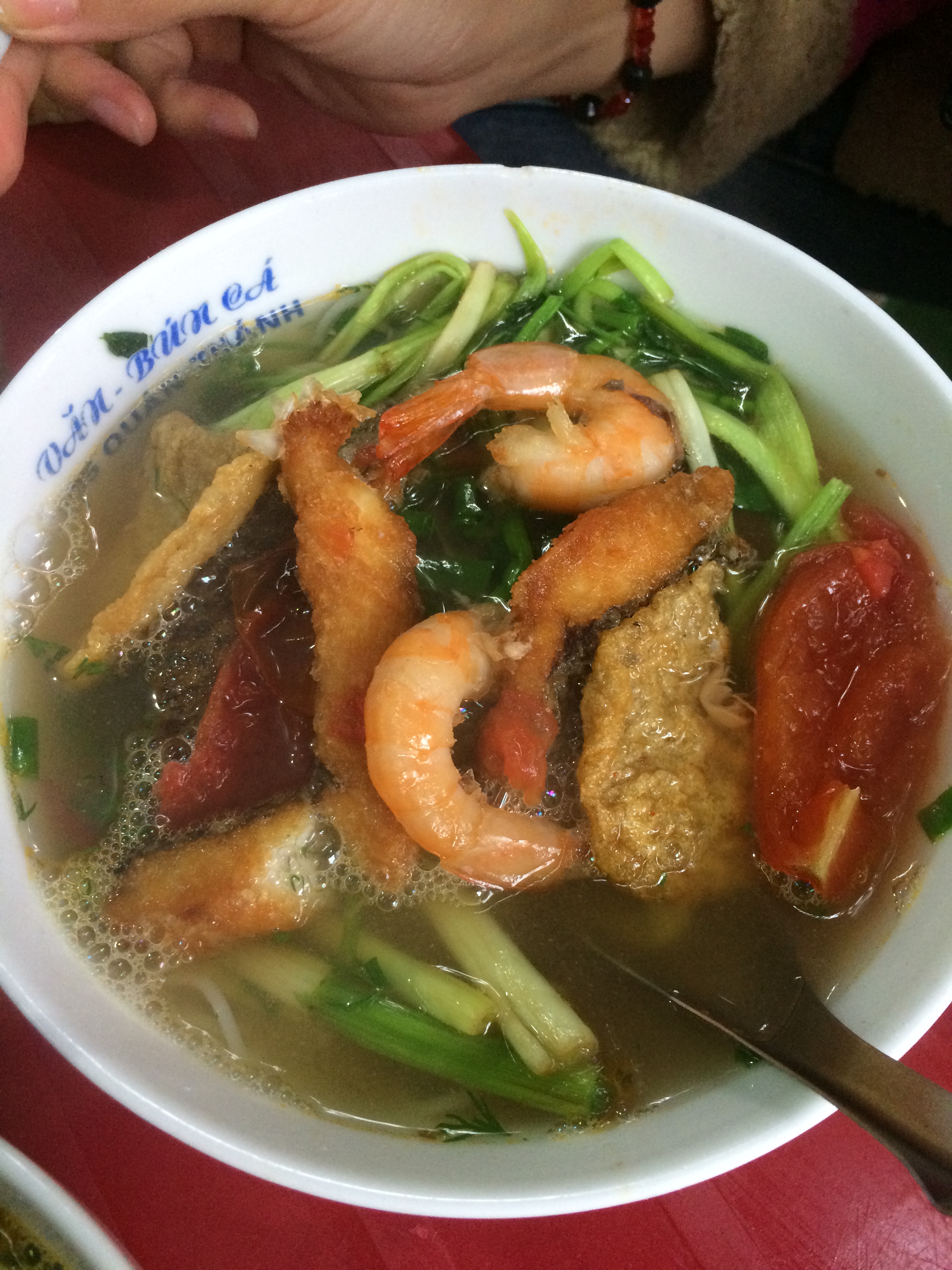
We start with a short taxi ride across the city and arrive at a small street with a stall where many residents are sitting down enjoying their breakfast of Bun Ca, a soup made with crispy fish cakes, prawns, noodles, morning glory and other fresh herbs. Giang shows us a large pot and explains how the soup broth is made from fish bones and tomatoes as the dish is prepared for each customer.

I’m not generally a fan of noodle soups, especially for breakfast, but this dish may have swayed me. Yum! The broth had so much flavour and all the ingredients were fresh and crisp to taste, especially the morning glory and the fish cakes. It was tempting to drain the bowl but this was the first stop of the day and there are another three hours or so to our food tour and besides, for all my slurping the contents of my bowl didn’t seem to be diminishing.

Bun Ca, Hanoi Street Food Tour - Vietnam Culinary Discovery
Bun Ca, Hanoi Street Food Tour – Vietnam Culinary Discovery

Not far from the first station, we arrive at another small restaurant and watch with fascination as one girl ladles a mixture of rice flour and water onto a drum which steams and creates sheets of thin delicate crepes for Banh Cuon Thanh Tri (rice crepes). This is another breakfast specialty from Hanoi where the steamed crepes are then filled and rolled with minced pork and mushrooms, topped with fried shallots and served with Vietnamese pork sausage (Cha Lua), fresh herbs and a sweet fish sauce. It’s also delicious although mushrooms are not on list of favourite things to eat.

A few streets over, we come to a very small stall where a lady is selling Banh Mi which is one of my favourite dishes. The stall is extremely tiny with a small plastic table with a chopping board and microwave. I’m watching the baguette being prepared and feeling a little sheepish as I think about the small kitchen I used to have in my previous apartment and how I hated cooking there – in hindsight that kitchen seemed enormous compared to the space that this lady was working with. Wrapped in newspaper, Kylie and I received half a warm Banh Mi each. If I liked Banh Mi before, I absolutely love it now. This sandwich was simply made with only a few ingredients – pate, sliced pork belly, fresh coriander, sliced pork sausage and the flavour is amazing with the crispy baguette served warm from being heated in the microwave for thirty seconds, making the bread soft in texture and bringing out the moisture in the meat.

We keep walking until Giang stops by a woman selling young green sticky rice (Banh com) and invites us to taste before purchasing a bag that is then wrapped in dried lotus leaves.

Walking further along the same street, Giang pointed out that we were in an area that specialises in selling wedding cakes and other supplies. Banh Phu The, commonly known as conjugal cake, has a thick jelly-like texture encasing a yellow cake mixture made from tapioca flour, pandanus, green bean, coconut and other ingredients. The stickiness of the cake symbolises a solid and eternal marriage, and just like the texture of the cake, the promises made by the bride and groom will also hold fast.

Around the corner, a woman is selling a mixture of rice, dried bean curd and crispy shallots which we sample. It’s not bad but probably pales in comparison against all the other delicious things that we have been trying so far.

We then come to a market where on the outskirts kitchen equipment is sold to wholesale customers. I really wanted to stop and look but we keep walking and as the market continues, we walk past dried fish and all manner of different ingredients being sold, occasionally looking at food stalls and watching families sitting together for breakfast. As we exited the market, a lady with a large pot on the back of her bicycle is selling tapioca root so Giang obliged us with buying a couple of pieces for Kylie and I to taste. It’s actually really delicious, just like boiled potato pieces but a little bit sweeter.

Walking through the Old Quarter through alleys and streets, Giang leads us to a stall selling Banh Oc which is a tomato and snail based noodle soup topped with spring onions (scallions). As I watched the vendor prepare the soup with a dash of shrimp paste, beef, chilli and cook the snails in the tomato broth, I didn’t have any apprehension whatsoever. Our soup looked elegant and inviting as we grabbed a spoon and chopsticks from the communal stand and started eating, although I will say that the broth had somewhat of an earthy flavour and the snails were hard and rubbery, but tasty just the same.

Banh Oc, Hanoi Street Food Tour - Vietnam Culinary Discovery
Banh Oc, Hanoi Street Food Tour – Vietnam Culinary Discovery

After finishing our sample of soup, we continued walking back towards the hotel. Some of the street vendors were selling different types of tropical fruit which were vastly different to anything that we had seen before. Giang bought a piece of caramel coloured sapodilla fruit for Kylie and I to try. Sapodilla usually has a soft melting texture and a sweet dessert-like flavour, however our piece hadn’t fully ripened but it was a great tasting experience nonetheless. One of my favourite fruits that I like to devour when I have the opportunity to travel in Asia is fresh jackfruit, so as we walked past another fruit vendor Giang obliged by purchasing a container of jackfruit to enjoy. Deliciously sweet to taste, it was just like how I remembered it and a great palate cleanser.

A quick stop at the hotel to freshen up and enjoy a cup of lemongrass and honey tea before continuing the final leg of our food tour. Only walking ten metres from the hotel lobby, we stop at a small restaurant selling Chè and take a seat at the counter. Chè is a traditional Vietnamese sweet beverage or dessert soup. Kylie and I watch with fascination as the vendor starts to fill two large glass mugs with a mixture of lotus seeds, green beans, black beans, big black beans, black jelly, coconut jelly, jasmine tea, coconut milk and shredded coconut. As I’m handed my dessert to try, my mind is telling me that this concoction of beans and milk isn’t going to taste very nice but I grabbed a spoon and dived in anyway.

It was surprisingly sweet and quite delicious – the combination of flavours and textures in the glass was quite enjoyable and a wonderful refreshment. Soups, crepes, rice, sandwiches, cakes, fruit and dessert all sampled in the space of a couple of hours, it was now time to find a coffee.

Giang led us through the streets of the Old Quarter to an obscure shop front where we walked down an alley and upstairs to a popular café selling Cà Phê Trứng (Vietnamese Egg Coffee), ironically called “Giang Café”. I love my coffee and I have been enjoying all manner of Vietnamese iced coffees since I arrived in Hanoi, but egg yolk in coffee is another specialty that I need to harden my stomach for. Served in small, elegantly decorated cups this coffee is made with Vietnamese coffee powder, egg yolk and sweetened condensed milk.

Vietnamese Egg Coffee at Giang Cafe, Hanoi Street Food Tour - Vietnam Culinary Discovery
Vietnamese Egg Coffee at Giang Cafe, Hanoi Street Food Tour – Vietnam Culinary Discovery

The thick-textured, rich, creamy and sweet coffee tasted exactly like a Vienna coffee but without the whipped cream. The taste was fantastic and probably one of the most enjoyable coffee experiences I have ever had. It was fun sitting on the small chairs with the local crowd, sipping the hot sweet coffee. Giang had also bought some bananas to dip into the young green sticky rice that we had purchased earlier to enjoy as a snack with the coffee.

Home

Although we were enjoying our time at the café, our departure time to Hue was drawing nearer and we still had one last Hanoi speciality to enjoy – beer or Bia Hoi. The beer café that our local guide had in mind wasn’t quite ready to serve us at that time in the morning, so we went back to the hotel to collect our luggage and make use of the tour car.

En route to the airport, we made a detour to another popular beer café, Trung Tao Ngộ Quán III – Bia Hơi Hà Nội, for a farewell drink. Some of the locals were enjoying a brew together, so we didn’t feel so conspicuous sitting down and ordering a few glasses for ourselves although the clock hadn’t quite reached 11am!

I prefer wine to beer but this was actually quite nice. The café had a great outdoor setting with a tropical atmosphere, so I didn’t mind kicking back and sipping a cold beer mid-morning. With every good drink, you naturally need bar snacks so a plate of peanuts and parcels of banana leaves materialised on our table. Giang unwrapped the strange looking parcel to reveal a long thin, pink, cured pork sausage that is typically enjoyed with the local beer. Not unlike salami twigs, the sausages were quite tasty with hints of spice to counteract the beer flavour. In true beer hall style, I whipped out a pack of cards and we played a few rounds as we enjoyed our drinks and snacks. Before long, we attracted a small audience of café staff and clients who were a little intrigued by our card game. Unfortunately our unique street food tour, as well as our time in Hanoi, had come to an end.

Kylie and I bid a fond farewell to Giang and thanked her for our wonderful Hanoi experience. Next stop: Hue!

A short flight to Hue and we were welcomed by Huy, our local Travel Indochina guide for Central Vietnam and taken to our hotel located on the Perfume River. We spent the afternoon at our leisure and met our new guide later that evening to enjoy dinner at a local family restaurant located near the hotel.

At the appointed time, Huy took us to a simply furnished restaurant across the street called “Banana Mango” to enjoy a set menu of Hue specialties, including crispy rice pancake. Our meal was quite good although I think given our food-filled morning, eating was starting to become hard work!

http://www.tripadvisor.com.au/Restaurant_Review-g293926-d1422380-Reviews-Banana_Mango-Hue_Thua_Thien_Hue_Province.html

Disclaimer: All entries regarding the Vietnam Culinary Discovery tour within this blog reflect my own personal insights and experiences throughout my holiday and I was solely responsible for meeting all travel expenses incurred.

Vietnam Culinary Discovery – Days 3 & 4, Hanoi – Halong Bay – Hanoi

Monday 1st December, 2014

This morning Kylie and I are up early to pack our overnight bags for our trip to Halong Bay and check out of our accommodation in Hanoi. It’s never a dull moment on our trip as Kylie points out that the sliced papaya on the breakfast buffet is captioned as “Watermelon Margarita” … if only my parents had made up exotic cocktail names for fresh fruit when I was younger, I might have eaten more of it.

Lost in translation ... Papaya is also known as "Watermelon Margarita" in Vietnam
Lost in translation … Papaya is also known as “Watermelon Margarita” in Vietnam

Being Monday morning, everyone seems to be out on the roads on their motorcycles trying to get to work or school. At first glance, the traffic in Hanoi seems to be utter chaos, but the more you look and concentrate, all the drivers seem to be doing an elaborate dance around each other, all aware of everyone’s movements and changing direction with impeccable timing.

With motorcycles being the primary mode of transportation in Vietnam, you see incredible things being carried or tied to the back of them – crates of chickens, bundles of baguettes, gas cylinders and even water buffalo!

Have water buffalo, will travel ... the things you can transport on your motorcycle in Vietnam
Have water buffalo, will travel … the things you can transport on your motorcycle in Vietnam

Our trip to Halong Bay is approximately 170 kilometres from Hanoi which in Vietnam equates to a four hour drive, although being accustomed to driving in rural Australia the maths doesn’t really compute in my mind until you comprehend the speed restrictions and the volume of traffic. Most of our journey passes through the Red River Delta agricultural area so there are lots of beautiful market gardens, fields and pottery villages to capture our attention. To break our trip we stop at the Humanity Centre which houses a school and workshop to enable students with disabilities arising from the effects of Agent Orange, to support themselves and their families by selling their own art and other handmade souvenir items. Time flies being in a shopper’s paradise but it’s impossible to resist the call of Vietnamese coffee available from the onsite café.

My favourite time of the day ... Vietnamese drip coffee with sweetened condensed milk
My favourite time of the day … Vietnamese drip coffee with sweetened condensed milk

En route to Halong Bay, our guide Giang is notified that all cruises in the area have been temporarily suspended by the Vietnamese Government since the previous day due to significant storm activity in the area, so we continue onwards with our fingers crossed that the bay will be re-opened shortly. Good fortune is on our side for just as we near the port of Hon Gai, the gateway to Halong Bay, Giang receives a call advising that all cruising operations have been given the all clear to recommence.

Excitedly grabbing our overnight bags, we walk along the long jetty to a small boat that will transfer us out to the larger junk boat that we will be cruising on for the next 24 hours. We spend the next hour checking out our accommodation and keeping out of the wind and rain that seem to have set in for the rest of the day.

As soon as we set off for Halong Bay, we retreat up to the main cabin for a delicious lunch consisting of multiple courses. The flavours of the fried fish dish evoke wonderful memories of my Baba’s cooking when I was much younger and I’m almost tempted to ask for a recipe to replicate at home.

Halong Bay is a UNESCO World Heritage Site and one of Vietnam’s greatest natural wonders, consisting of approximately 3,000 small limestone islands and formations. Late in the afternoon, our junk boat arrives at Bo Hon Island and we trek up to Hang Sung Sot, also known as the Cave of Awe to see the famous rock shapes illuminated with coloured lights inside the caverns.

Hiking is thirsty work and as the sun sets it’s time for a glass of red wine and a few rounds of cards while the onboard chefs are busily preparing the evening banquet. A couple of hours later our card tournament is put on hold to make way for another eight course meal: Pumpkin Creamy Soup, Russian Style Salad, Grilled Oyster “Huong Hai” Style, Fried Tiger Prawn with Green Bay Sauce, Huong Hai Fried Spring Rolls served with traditional fish sauce, Roasted chicken with honey, Steamed fish with tropical spice, Steamed rice, Stir-fried seasonal mixed vegetables and crème caramel. Unfortunately I wasn’t able to photograph the latter dishes as my mobile phone was commandeered for musical entertainment. I think the kitchen staff may have had a lot of time on their hands as most of the plates were decorated with elaborate cucumber designs but needless to say, the meal was absolutely delicious.

Tuesday 2nd December, 2014

Good Morning Vietnam! Our day started with a light breakfast before heading to Dao Titop, a small islet, to climb the four hundred-odd steps to the top and capture the stunning views of Halong Bay from the lookout. Although the rain had abated temporarily, the stone steps were wet and slippery, so it was slow going in some places but the spectacular vistas that greeted us at the peak made the steep climb seem trivial.

After taking a breather and as many photos as our mobile phones could manage, we made our descent back towards the boat and spent the rest of the morning packing our things before enjoying a leisurely brunch before arriving back into port.

Driving back towards Hanoi, we passed through the same rice paddy fields and villages as the previous day, but Giang had our driver pull over to allow us to visit a large garden and smell the fragrant coriander, mint and other herbs for ourselves. Everything was green, ordered and abundant as we wandered through the narrow pathways between allotments. A local farmer in a traditional conical hat was working in her small field of lettuce, getting ready for the next day’s market. The small field next to her also contained lettuce, but the allotment was beautifully decorated with Vietnamese mint around its perimeter.

Arriving back in Hanoi mid-afternoon, Kylie and I are in desperate need of some rest and recuperation after our early start to the day. As this is the last night in Hanoi and after talking up my enjoyable Cau Go Restaurant experience, Giang has booked us a table for the evening and another set menu to enjoy. With spectacular views of the city and Hoan Kiem Lake, we enjoy another delicious dinner of Shrimp and squid salad with mixed vegetables, Deep fried egg tofu with lemongrass and chilli, Deep fried squid in tamarind sauce, Boiled vegetables with chef’s sauce, Stewed pork in traditional pot with egg, Minced pork soup with vegetables, Steamed rice and Fried Banana.

http://caugovietnamesecuisine.com/

There have been a lot of banquet-style restaurant dinners for the first couple of days of tour, however Hanoi is famous for its delicious and plentiful street food which we are going to immerse ourselves in tomorrow.

Disclaimer: All entries regarding the Vietnam Culinary Discovery tour within this blog reflect my own personal insights and experiences throughout my holiday and I was solely responsible for meeting all travel expenses incurred.